

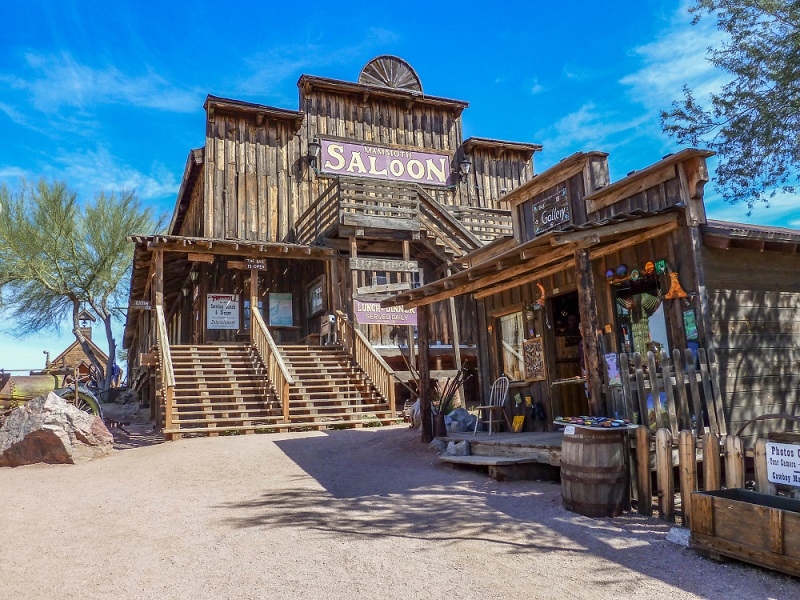
There is something about a ghost town that gets people every time. Maybe it is the creaky wood, maybe it is the desert backdrop, maybe it is the idea that a place can boom, fade, and somehow still hang around long enough to become a weekend plan. That is a big part of the appeal of the Goldfield ghost town, Phoenix. Technically, it is not in Phoenix proper. It is in Apache Junction, about 4.5 miles northeast of Apache Junction on the historic Apache Trail, with the address listed as 4650 N. Mammoth Mine Road. But for plenty of visitors staying in Phoenix or the East Valley, it lands in that easy day-trip zone.
And that is kind of the sweet spot. It feels far enough from the city to feel like a little escape, but not so far that it turns into an all-day logistics problem. People can walk the old-style main street, check out the mine tour, ride the narrow-gauge train, wander through shops, and soak up that staged-but-still-fun Wild West atmosphere. The official site also highlights the museum, gold panning, and gunfight shows as part of the draw.
This is worth clearing up early because the keyword can make it sound like the town sits right in central Phoenix. It does not. Goldfield ghost town, Phoenix, is really a shorthand people use when they are searching for things to do from Phoenix. The town itself is in Apache Junction, near the Superstition Mountains and along the Apache Trail. That setting matters because it gives the whole place its look and mood. The mountains do a lot of heavy lifting. Without that backdrop, it would still be interesting, but maybe not quite as cinematic.
The official site describes it as a gold mining town where visitors can explore historic buildings, tour the Mammoth Gold Mine, visit the museum, pan for gold, and ride Arizona’s only narrow-gauge train. That line alone explains why it works so well for casual visitors. It is not trying to be one thing. It is part local history stop, part family attraction, part photo-friendly Old West outing.
The best thing about Goldfield is that there is actual history underneath the tourist setup. According to the official site, back in the 1890s Goldfield had three saloons, a boarding house, a general store, a blacksmith shop, a brewery, a meat market, and a schoolhouse. Then the ore grade dropped, the vein faulted, and the town faded. The site also says there were several unsuccessful attempts to reopen the mines, and that the area came back to life on and off from 1910 until 1926.
That is where the Goldfield ghost town history gets more interesting than people expect. It is not just a made-up cowboy strip built for tourists from scratch. There really was a mining settlement here, and the place really did go through that boom-and-bust cycle that shaped so much of the American West. The Apache Junction Public Library’s local-history write-up adds that Bob and Lou Ann Schoose later rebuilt and developed Goldfield Ghost Town as a family project, helping preserve mining history and local heritage for future visitors.
So yes, it is tourist-friendly now. But it also has roots. That combination tends to make a place more memorable.
This is the question people usually ask, and honestly, it is a fair one: Is Goldfield a real ghost town?
The most honest answer is yes, but with an asterisk. Goldfield was a real mining town that declined after the ore vein faulted and later saw failed reopening efforts. That part is historical. The current version, though, is a restored and rebuilt attraction built around that original site and its story. The Apache Junction Public Library’s history page makes that especially clear by describing the rebuilding effort led by Bob and Lou Ann Schoose, while the official Goldfield site frames the present-day town as a place visitors now enjoy for Wild West history and attractions.
So if someone means “Is it an untouched abandoned town where everything has just sat there for a hundred years?” then no, not really. If they mean “Was this based on a real ghost town with a real mining past?” then yes. And honestly, that middle-ground answer is probably what makes it accessible. It still gives people the atmosphere, but with bathrooms, tours, and a coffee shop. Not the worst compromise.
Check Out: Experience the Beauty of the Sonoran Desert Landscape
This is where Goldfield becomes more than just a quick photo stop. The official attractions page lists the Superstition Narrow Gauge Railroad, Goldfield Mine Tours, a museum, gold panning and gem sluicing, the Mystery Shack, seasonal gunfighter shows, and a walking ghost tour operated by Fear Frontier. The train ride lasts about 20 minutes, the mine tour about 25 minutes, and the train and mine attractions both run seven days a week according to the site.
That mix is a big reason families tend to like the place. There is enough to do that people do not feel stuck just strolling a dusty street pretending to be impressed by wooden facades. At the same time, it does not feel overbuilt in the theme-park sense. It still leans into the ghost-town identity instead of burying it under too many modern distractions.
And for adults? The draw is often simpler. Desert views, old signage, mine lore, saloon energy, and a setting that photographs ridiculously well.
Anyone thinking of visiting should check the current schedule before heading out, because Goldfield ghost town hoursare not identical across every part of the property. On the official site, merchants are listed as open from 10 a.m. to 5 p.m., the coffee shop from 9 a.m. to 4:30 p.m., and the train and mine tour from 10 a.m. to 5 p.m., seven days a week. The saloon is listed as open daily, but with summer hours varying, and the site says to call for that. The homepage also posts special closures when needed, such as its notice that the town will be closed on Easter Sunday.
That is a useful reminder because visitors sometimes assume everything inside a place like this runs on one neat timetable. Not always. It is smarter to treat Goldfield ghost town hours as a quick pre-trip check, especially if the train or mine tour is the main reason for going.
Some travelers get weirdly stubborn about places like this. If it is polished at all, they write it off. But that misses the point. Goldfield does not really sell itself as a raw archaeological ruin. It sells itself as a revived Wild West destination rooted in actual local mining history. That is a different promise, and it is worth judging on those terms.
The best mindset is to go in wanting a fun, slightly theatrical Arizona stop with some legitimate history under it. If someone expects a silent abandoned settlement untouched by time, they may leave grumpy. If they expect a desert day trip with mine history, train rides, old-west storefronts, and a dose of staged frontier charm, they will probably have a much better time.
That is why Goldfield ghost town history matters. It gives the place weight. And it is why the question Is Goldfield a real ghost town? keeps coming up. People want to know whether there is something real underneath the performance. There is. Just not in the purist, no-gift-shop version.
Read More: Why You Should Attend Fall Festivals in Phoenix, AZ Now
Goldfield keeps showing up on lists for a reason. It is easy to reach from the Phoenix area, visually memorable, and broad enough to work for different kinds of visitors. Families can do the train and mine tour. Couples can wander and take photos. History fans can dig into the mining backstory. People who just want an Arizona-feeling outing get exactly that.
And that is probably the real reason the Goldfield ghost town in Phoenix remains popular. It is not pretending to be deeper than it is. It gives people a slice of Old West atmosphere, a link to Arizona mining history, and enough attractions to make the stop feel worth it. Sometimes that is all a place needs to do.
No. Goldfield Ghost Town is in Apache Junction at 4650 N. Mammoth Mine Road, though many people search for it as a Phoenix-area day trip.
According to the official site, merchants are open 10 a.m. to 5 p.m., the coffee shop is open 9 a.m. to 4:30 p.m., and the train and mine tour run 10 a.m. to 5 p.m., seven days a week. Saloon hours can vary in summer.
This content was created by AI